News
Published over 11 years ago. See the latest and most current information on News.
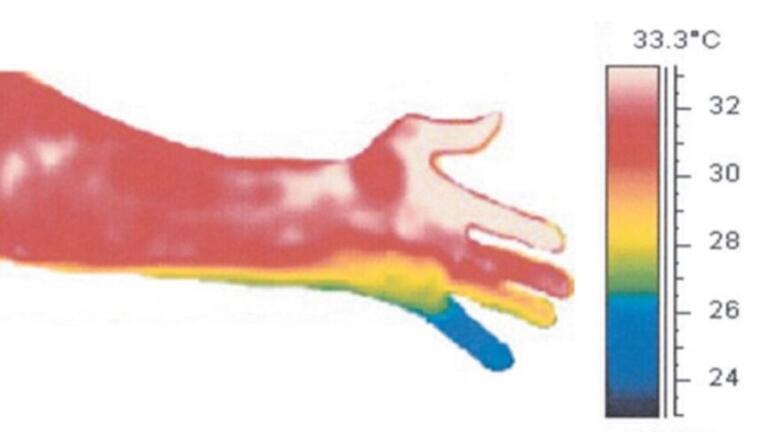
Thermal imaging is a process that uses infrared radiation to produce an image. All objects with a temperature above absolute zero produce infrared radiation as a result of their motion due to thermal energy. The image produced, a thermograph, is a map of the relative infrared intensities from an object and its surroundings.
Thermal imaging has many benefits and is a widely used technique with many scientific applications. An advantage is that it is a non-contact method, so it can operate at a distance from the source. Additionally, it is a non-destructive method and so it preserves the sample’s integrity.
The benefits of thermal imaging mean it is ideally suited to use in a medical capacity. The technique uses the heat from your body to assist a medical practitioner to make a diagnosis. Because of the temperatures involved the equipment needed is relatively simple. Consequently, the training and use of the equipment is relatively easy and makes thermal imaging a low cost method.
A doctor can quickly assess the resulting thermograph to determine if there are any warm or cold regions. For example, a warm region might indicate an increased blood flow. Correspondingly, a colder area could indicate reduced blood flow. These anomalies can indicate conditions such as breast cancer or vascular disease.
New developments in the medical use of thermal imaging happen constantly. A recent development, highlighting the non-contact benefits of thermography, is discussed in this article: Thermal Imaging Cameras Confirm Effectiveness of Local Anaesthetics.
William Herschel is credited with the discovery of infrared radiation in sunlight in 1800. In an experiment he conducted, a region in sunlight just beyond visible red light, now identified as infrared gave the largest temperature increase. Two key factors meant that infrared astronomy progressed relatively slowly until recent years:
Since modern detectors were launched into space and operated on satellites, starting with the Infrared Astronomical Satellite (1983), fantastic discoveries have been made. Further major space missions have followed: Infrared Space Observatory (1995) and Spitzer Space Telescope (2003).
Observations carried out by these telescopes include:
Space telescopes use liquid helium to cool the detectors and telescope to nearly absolute zero. This is necessary to stop the detector being flooded with infrared from the telescope itself. Spitzer used the last of its helium in 2009, and the spacecraft gradually warmed to -242°C. For this reason it is no longer able to detect certain infrared wavelengths, although it is still collecting infrared data at other wavelengths.
ILM 51.5 July 2026




 Product directory


.jpg)
.jpg)





-(1).jpg)