Laboratory products
Published over 5 years ago. See the latest and most current information on Laboratory products.
Flow meters are used across a wide range of industries as indispensable measuring tools. Commercial applications range from measuring the fuel feeding industrial boilers, for flow monitoring of lubricant supply lines for wind turbines, to dosing chemicals for agricultural sprays. Domestically, flow meters are installed to manage the dispensing of beer or coffee and built into washing machines and dishwashers to meter efficient water usage.
Turbine flow meters are invaluable measurement tools, and their repeatability and linearity are the key elements that determine the flowmeter’s performance and overall accuracy. Both the mechanical properties of the flow meter and the physical properties of the fluid combine to influence the general performance of the flow measurement device.
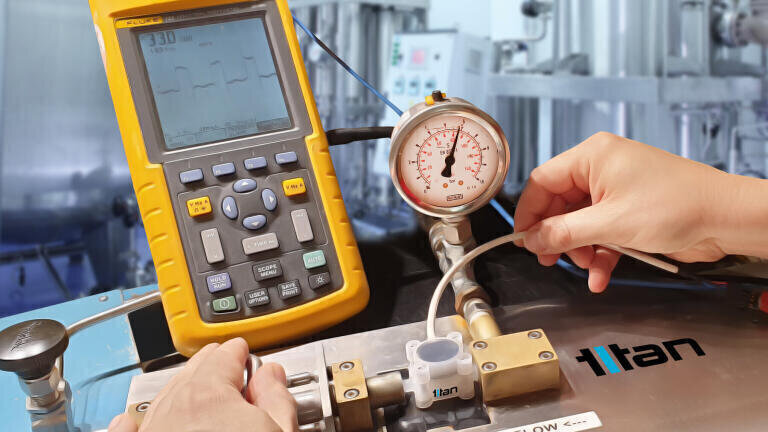
A new technical article focusing on flow meter performance is available from Titan Enterprises. This informative article discusses the factors involved in determining the overall performance of pulse output turbine flow meters and how each factor influences the accuracy of flow measurement.
Terms synonymous with calibrating flow meters - the K-Factor, calibration uncertainty, repeatability, accuracy and linearity - are all explained. The technical article discusses the relationship between all these flow factors and how they each influence the overall performance of a flow meter.
Whereas turbine flow meters, such as Titan’s Beverage flow meter and 800 series, offer the high level of repeatability and reliability required for accurate batch delivery systems, Titan’s Atrato® and Metraflow® ultrasonic flow sensors and the larger oval gear flow meters, are highly accurate over wider flow ranges, especially with viscous liquids such as oils.
Neil Hannay, Senior R&D Engineer with Titan Enterprises, explained: “When customers are deciding on appropriate flow meters to suit their application, they need to be aware of the difference between FSD linearity and ‘of reading’ linearity accuracy, as often suppliers do not specify which accuracy is being quoted for.” The technical article from Titan illustrates how the linearity reading has a significant impact on the performance of the flowmeter, particularly at the low end of its flow range.
Read the technical article in full.
More information online
ILM 51.6 Sept 2026

 Product directory