News
Published over 7 years ago. See the latest and most current information on News.
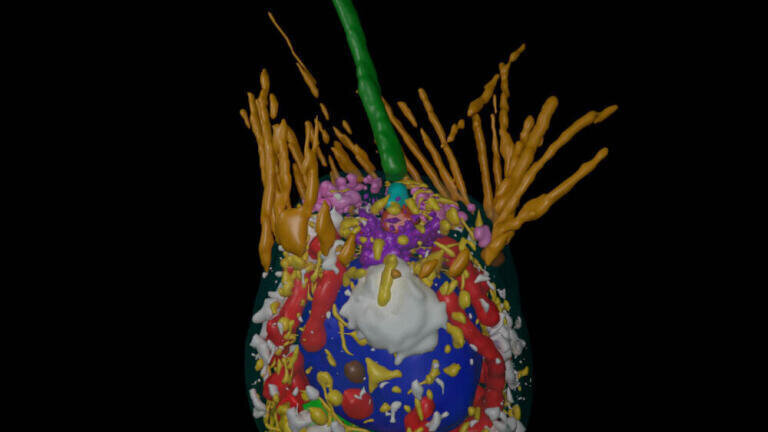
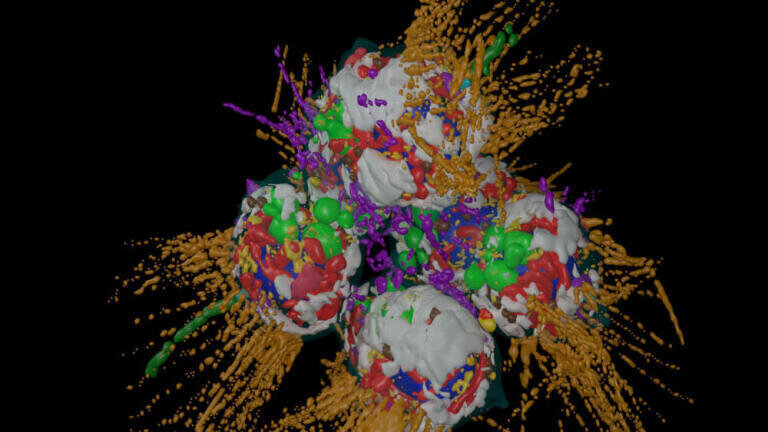
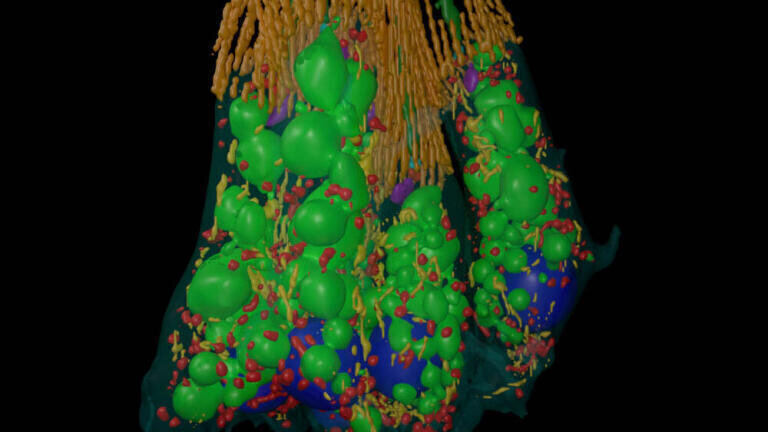
In collaboration with researchers at the University of California, Berkeley, a new Marine Biological Association (MBA) study has reconstructed detailed 3D images of cells that represent the closest cousins of the animals. This new work peels back the mysteries of how cells differentiated leading to the appearance of animals.
Research, led by MBA research student Davis Laundon and former MBA research fellow Pawel Burkhardt, focused on choanoflagellates, a type of microscopic aquatic organism that is the closest single-celled relative of animals. Choanoflagellates are a free-living form of ‘collar cell’, a type of cell found within many kinds of animals from sponges to starfish, which can exist as single cells and in multicellular form. Studying the structure of the choanoflagellate collar cell can therefore shed light on how animal multicellularity and cell differentiation may have evolved.
This study compared the internal structure of single-celled and multicellular choanoflagellates, as well as the collar cells from a marine sponge, one of the most early-evolving animals. To create these striking images, Laundon and colleagues used transmission electron microscopy on ultrathin sections of the cell. The 3D reconstructions were then analysed to reveal their internal structure and clues to how they may differentiate into other cell types.
A significant finding is that when choanoflagellates divide into ‘colonies’, differentiated cell types are observed. MBA PhD student Davis Laundon described the findings “as an important step in our understanding of the biology of the last common ancestor of the animals”.
The first animals originated from the sea and this work shows how important studies of marine ‘model’ organisms are for advancing our knowledge of fundamental biology.
ILM 51.6 Sept 2026




 Product directory