News
Published over 13 years ago. See the latest and most current information on News.
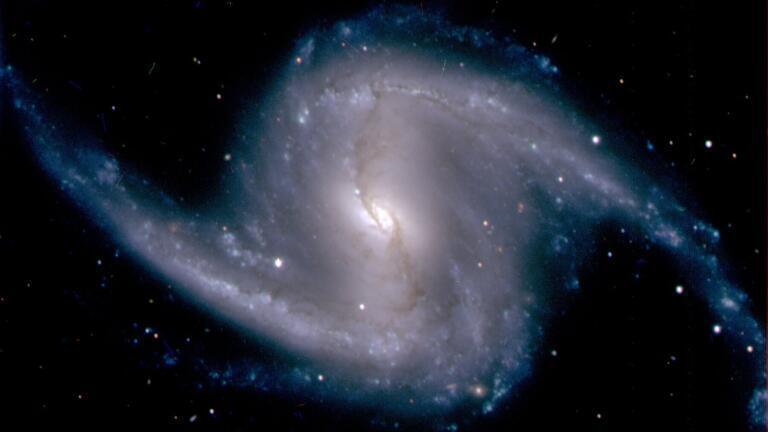
Ancient starlight transmitted from distant galaxies eight billion years ago has been captured and recorded for the first time on a mountain top in Chile by the newly-constructed Dark Energy Camera, the most powerful sky-mapping machine ever created.
The 570-megapixel camera, the product of eight years of planning and construction by scientists, engineers, and technicians on three continents, involved in the Dark Energy Survey (DES), captured the images on September 12th.
UK astronomers are key players in the DES collaboration, which is led by Fermilab in the US. The UK consortium comprises UCL (University College London), Portsmouth, Cambridge, Edinburgh, Sussex and Nottingham. The construction of the DES Camera was partially supported by UK’s Science and Technology Facilities Council (STFC).
Professor Ofer Lahav, from UCL, who heads the DES:UK Consortium and the DES science committee commented: “The achievement of first light through the Dark Energy Camera brings us a step closer to understanding dark energy, one of the biggest mysteries in the whole of physics. The deep observations with the DES camera will tell us why the universe is speeding up and if a major shift is required in our understanding of the universe.”
Starting in December the camera will undertake the largest galaxy survey ever conducted over five years, using the data to carry out four probes of dark energy; studying galaxy clusters, supernovae, the large-scale clumping of galaxies, and weak gravitational lensing..
The survey will create detailed colour images of one-eighth of the sky, or 5,000 square degrees, to discover and measure 300 million galaxies, 100,000 galaxy clusters, and 4,000 supernovae.
In addition to STFC’s contribution, DES is supported by funding from the U.S. Department of Energy; the National Science Foundation; and funding agencies in Spain, Brazil, Germany, and Switzerland; and the participating DES institutions.
ILM 51.6 Sept 2026




 Product directory














.jpg)
,-photo-Karin-Allander.jpg)