News
Published over 13 years ago. See the latest and most current information on News.
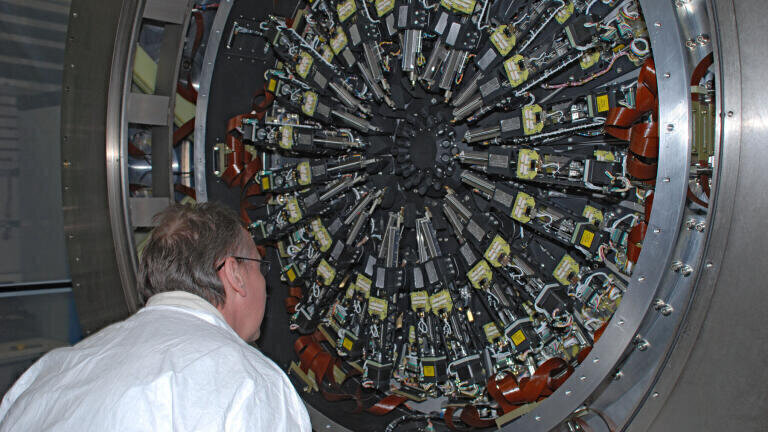
A new high-tech instrument –the K-Band Multi Object Spectrometer (KMOS) with 24 robotic arms has been provisionally accepted by the European Southern Observatory (ESO) after it completed final assembly and testing at the UK Astronomy Technology Centre (UK ATC) in Edinburgh. It will now be fitted to one of the four telescopes which make ESO’s Very Large Telescope (ESO-VLT) at Paranal in Chile, providing astronomers with a far quicker solution to uncover details about galaxies and their properties.
Each of the 24 cryogenic robotic arms, which have gold plated mirrors on their tips, can be moved into position to pinpoint with extreme accuracy the light coming from distant galaxies.
Dr Michele Cirasuolo is the lead instrument scientist for KMOS at UK ATC. He said: “KMOS represents a pivotal step in our quest to scrutinise the distant Universe. The ability to observe in the near-infrared 24 galaxies simultaneously is an enormous leap forward compared to any other current instrument. KMOS will allow a much faster survey speed - most of the observations done by similar near-infrared spectrographs over the last 10 years could be done in just two months with KMOS.”
“For each of the galaxies, KMOS will give an incredible amount of information. It’s not just a picture of a galaxy, but 3D spectroscopy providing the spatially resolved physics and the chemistry and the dynamics. This is crucial to understand how galaxies assemble their mass and shape their structure as a function of cosmic time, up to the formation of the very first galaxies, more than 13 billion years ago” he explained.
The instrument is a collaboration of six institutions in Germany and the UK, including STFC’s UK Astronomy Technology Centre (UK ATC), Durham University, Oxford University and RAL Space at STFC’s Rutherford Appleton Laboratory.
Each incredibly powerful unit telescope on the VLT contains a mirror eight metres in diameter. It is onto the VLT Unit 1 telescope, Antu that the new KMOS equipment will be fitted.
ILM 51.6 Sept 2026




 Product directory



















.jpg)
,-photo-Karin-Allander.jpg)