News
Published over 8 years ago. See the latest and most current information on News.
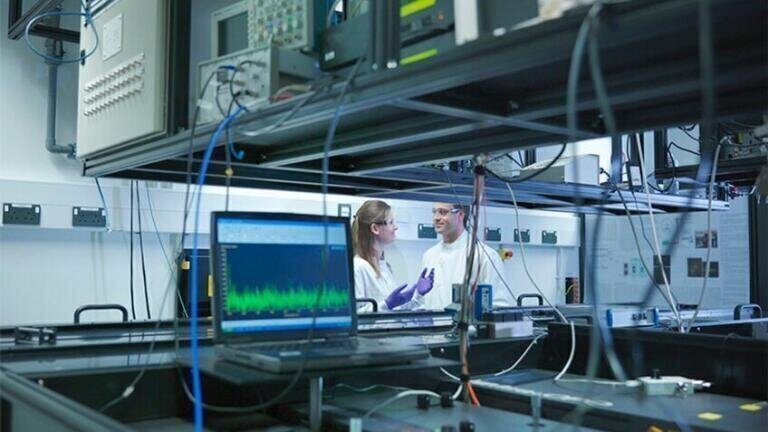
Researchers from York University and STFC’s world-leading Central Laser Facility (CLF) have used CFL’s Ultra Laser to develop a new technique for studying chemical catalysts. Chemical and pharmaceutical manufacturing is worth around £18billion to the UK alone and approximately 80-90% of the products made in the chemical industry are reliant on catalysts to speed up chemical reactions. How these processes work is not well understood and advances in this understanding could result in making the process cheaper or more efficient, something which is crucial for such a huge industry.
The researchers focused on manganese, a cheap and sustainable metal, aiming to understand how it performs the crucial step of forming carbon-carbon bonds by direct observation of the compound(s) responsible for the key reaction steps. This is not normally possible due to the extremely fast reaction times and very low levels of compound active in the process.
Applying the Ultra laser system to a catalyst triggered the generation of substantial amounts of the catalyst intermediates so that their behaviour could be observed more easily, enabling scientists to study reactions over a wide range of timescales, from extremely short (picoseconds) to much longer (milliseconds) – said to be equivalent to studying events occurring from one second to over three years in a single experiment.
ILM 51.6 Sept 2026


 Product directory


.jpg)
.jpg)