Temperature control and sterilising
Published over 3 years ago. See the latest and most current information on Temperature control and sterilising.
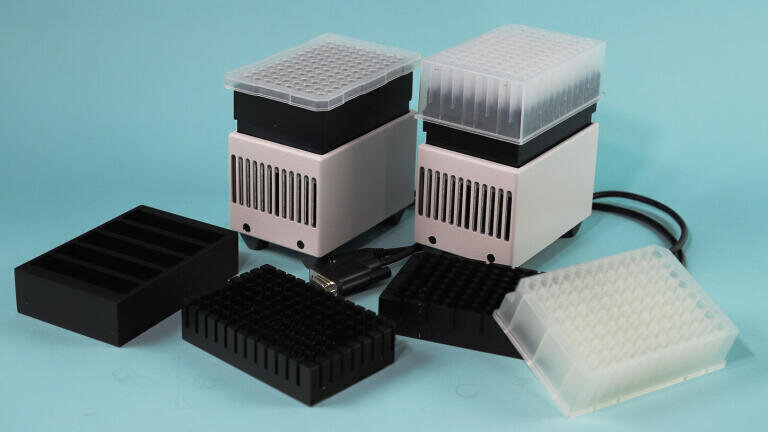
Torrey Pines Scientific are pleased to unveil the EchoTherm™ RIC40, a Peltier-driven, compact Heating/Chilling Dry Bath. This cutting-edge device offers a wide temperature range from 0.0ºC to 100.0ºC, catering to the diverse needs of robotic systems in the laboratory.
Controlled through the RS232 I/O port on each RIC40 unit, this compact solution measures 4.9” (125 mm) in length, 3.3” (82 mm) in width, and 3.9” (99 mm) in height without a sample block. To enhance its functionality, mounting brackets for Tecan decks and a variety of precision-made aluminium sample blocks are available as optional accessories.
With a remarkable temperature stability of +/- 0.2ºC and accuracy to +/- 0.2ºC, the RIC40 ensures precise and reliable temperature control, vital for obtaining consistent and reproducible results. Each unit comes complete with a heater/chiller module, universal power supply, AC line cord tailored to the country of use, RS232 interconnect cable, and comprehensive instructions, including the Serial Command Set.
The EchoTherm™ RIC40 complies with ETL, CSA, and CE standards, assuring the highest levels of safety and performance in your laboratory operations.
More information online
ILM 51.6 Sept 2026



 Product directory