Gas chromatography
Published over 10 years ago. See the latest and most current information on Gas chromatography.
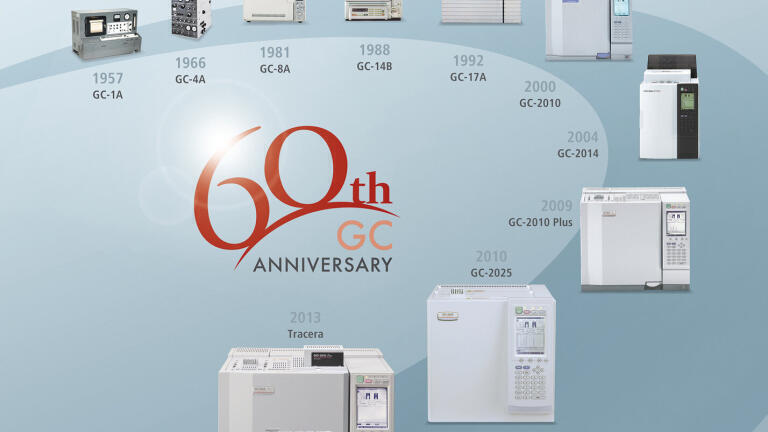
Shimadzu celebrates its 60th GC anniversary in 2016. In Shimadzu’s 140-year history, chromatography has set many milestones that have meanwhile become technical standards serving consumer protection, environmental protection and product safety today.
The practical implementation of the first gas chromatograph for the separation of complex mixtures via partition chromatography is generally attributed to the British scientists A.J. Martin and A.T. James, and Martin was awarded the Nobel Prize in 1952 for this. Shortly after, Shimadzu embarked on this technology and in 1956 developed the first gas chromatograph in Japan, which led to series production of the GC-1A in 1957. At 120 kg, it was a giant compared to today’s much smaller, more powerful and more versatile instruments. With this development, Shimadzu pushed forward the legacy of the founding family of Genzo Shimadzu Junior, one of the ten most important inventors of Japan honoured by the emperor at the time.
‘Contributing to Society through Science and Technology’ is Shimadzu’s core philosophy. This includes continuous development of existing technologies to explore opportunities and to push existing technical boundaries. This has made Shimadzu a market leader and an established name in science and industry.
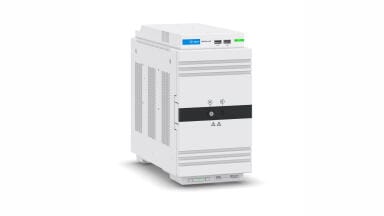
Much of what has been technically established in GC today has been achieved through hardware and software milestones. Between the first GC-1A and the current ultra-modern, universal Tracera system with its novel BID (barrier ionisation discharge) detector that can detect all substances except helium and neon, there are numerous world premieres, advances in performance and innovations that have set technical and economic trends and standards.
Today, routine as well as high-end systems define Shimadzu’s product range, from small, versatile systems and ultra-sensitive and highly productive systems to instruments that break new technological ground, for instance the multiple heart-cut technology. Many detectors with innovative technologies such as the BID helium ionisation detector complete the picture. System solutions like detector-switching or splitting, back-flushing or autosamplers provide customised as well as flexible applications.
ILM 51.6 Sept 2026





 Product directory