Laboratory events news
The Blavatnik Family Foundation and The New York Academy of Sciences have named three 2026 Blavatnik Awards for Young Scientists in the UK, recognising early-career research in telomerase structure, cellular electron transfer and planet formation
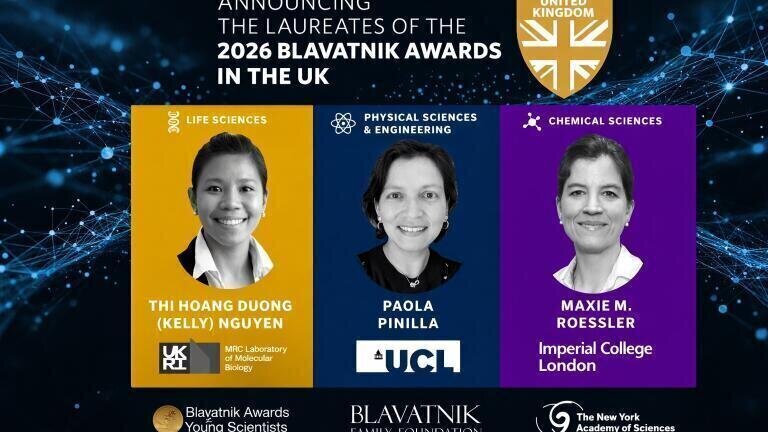
The Blavatnik Family Foundation and The New York Academy of Sciences have announced the three 2026 laureates of the Blavatnik Awards for Young Scientists in the UK – each of whom will receive £100,000. The laureates were revealed at a gala dinner and awards ceremony at the Banqueting House in London at the end of February, with awards across life sciences, chemical sciences, and physical sciences and engineering.
The 2026 laureates were selected from nine finalists and the six remaining finalists will each receive £30,000 in recognition of their scientific contributions. The organisers said it was the second time that all three laureates were women scientists within the UK.
In the life sciences category, the award went to Dr Thi Hoang Duong (Kelly) Nguyen, of the Medical Research Council Laboratory of Molecular Biology. Her work has focused on telomerase, the enzyme that maintains telomeres, the protective structures at the ends of chromosomes that shorten as cells divide. Telomerase activity has crucial links to cell longevity and genome stability, and researchers have associated its dysregulation with conditions that include premature ageing syndromes and cancer.
The organisers said Dr Nguyen applied cryo-electron microscopy, a technique that enables researchers to infer molecular structure from large numbers of frozen snapshots of biological material, to produce the first atomic-level model of telomerase. That kind of structural information can help researchers to identify which regions of a complex biomolecule may offer the most plausible routes to therapeutic targeting.
In the chemical sciences category, the award went to Professor Maxie M Roessler, of Imperial College London, a bioinorganic chemist whose research examines how cells move electrons to power metabolism. Electron transfer sits at the heart of cellular energy conversion, yet many intermediate states exist only briefly and can prove difficult to capture with conventional measurement methods. The organisers said Professor Roessler developed novel electron paramagnetic resonance spectroscopy methods to probe these short-lived and reactive electron states.
Electron paramagnetic resonance spectroscopy is particularly valuable when unpaired electrons appear, as in many metal-containing biological systems and catalytic reactions. By clarifying how electrons occupy and move between states, such approaches can inform efforts to design catalysts and functional materials that use energy more efficiently or drive chemical transformations with fewer unwanted by-products.
In physical sciences and engineering, the award went to Dr Paola Pinilla, of University College London, whose research has examined the earliest stages of planet formation in protoplanetary discs which are the rotating, gas-rich and dust-rich structures that surround newly developing stars. Planet formation begins when dust grains collide, stick together and hence accumulate. Yet the process can stall if particles drift inwards too quickly or fail to clump.
The organisers said Dr Pinilla combined telescope observations with advanced modelling to identify pressure structures within discs that trap dust which can create favourable conditions for growth into larger bodies. Such structures can act as signposts that indicate where planets may form, and they can influence how water and other chemical building blocks distribute through a developing planetary system.
Professor Deborah Prentice, vice-chancellor of the University of Cambridge, presented the awards and announced the laureates during the ceremony.
“There are grounds for optimism about the future of [science in] this country. Current plans for growth in the UK economy rest heavily on science and technology. And decades of investment mean the UK’s educational infrastructure is incredible – drawing in talent, using it superbly and efficiently,” she said.
Sir Leonard Blavatnik, founder of Access Industries and the Blavatnik Family Foundation, said the awards reflected ongoing scientific strength in the UK.
“The exceptional talent celebrated through these Awards reflects the creativity and ambition that continue to place the UK at the forefront of scientific advance. It is a privilege to recognise their work and to support the next stage of their scientific journeys,” he said.
Professor Nicholas B Dirks, president and chief executive officer of The New York Academy of Sciences and chair of the awards’ Scientific Advisory Council, highlighted both scientific quality and representation.
“This is a remarkable group of laureates whose work reflects both scientific brilliance and real-world impact,” he said.
“Notably, this marks the second time in the history of the Blavatnik Awards in the UK that all three laureates have been women scientists. On behalf of The New York Academy of Sciences, we celebrate the representation and success of women in science and congratulate these winning Laureates,” he concluded.
The organisers said the Blavatnik Awards for Young Scientists constituted the largest unrestricted prizes available to scientists across the UK aged 42 or younger. Now in its ninth year in the UK, the programme aims to recognise research that could transform lives, extend scientific understanding, and address global challenges across various disciplines. An independent jury selected the 2026 laureates from 91 nominees representing 46 academic and research institutions across the UK.
Since the UK programme began in 2017, 73 honourees have shared nearly £3.3 million (US$4.5 million) in prize funding, which the organisers framed as flexible support for high-risk and high-reward research. The UK awards form part of a wider set that includes the Blavatnik National Awards and Regional Awards in the USA and the Blavatnik Awards in Israel.
The Blavatnik Family Foundation said it supports researchers and future leaders who aim to tackle major societal challenges. The New York Academy of Sciences, founded in 1817, described itself as an independent not-for-profit organisation committed to advancing science for societal benefit through membership, programmes, and educational initiatives across science, technology, engineering, and mathematics and related fields.
For updates about the Blavatnik Awards please visit www.blavatnikawards.org
ILM 51.6 Sept 2026




 Product directory
















.jpg)

.jpg)