Laboratory events news
Cell and gene therapies have moved beyond scientific promise into reality in the clinic. But wider adoption depends on better financing, stronger manufacturing systems, smarter automation. And, most significantly, health services and payers that can support their adoption at scale, according to Dr Stephen Ward
Cell and gene therapy (CGT) remains on an upward path despite recent market shocks, according to Dr Stephen Ward, chief technology officer at the Cell and Gene Therapy Catapult – a UK government-backed independent innovation organisation – who argued that the sector must now overcome barriers around scale, adoption and investment to succeed.
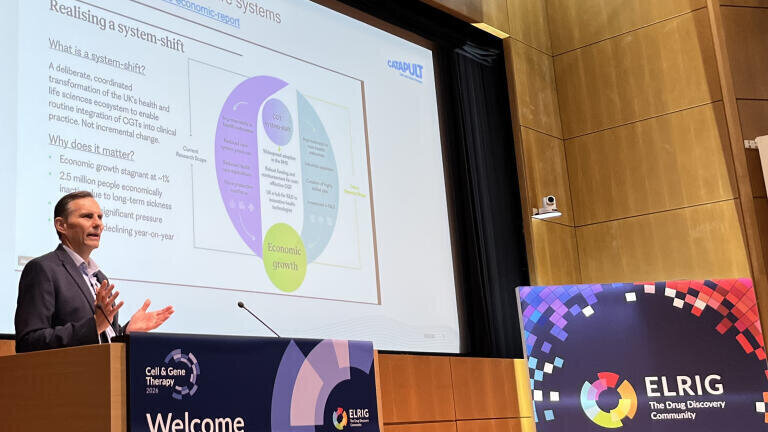
In a keynote address at Hinxton Hall, Cambridge, to kick off the ELRIG Drug Discovery meeting in March 2026, Ward said CGT had already proved they were not a transient scientific fashion. Instead, he presented them as an increasingly established part of modern medicine, with the capacity to reshape treatment for serious disease, influence industrial strategy and create value beyond the clinic. His central argument was that the science has advanced far enough to justify confidence but that the systems needed to deliver these therapies at scale were yet to catch up.
Ward said the field often captured the public imagination unlike most anything else. Its ability to translate what once appeared to be science fiction into real patient benefit, he suggested, has helped it gain attention beyond specialist circles. That resonance mattered because it could strengthen the case for policy support, reimbursement and long-term funding. For patients, the sector has offered treatment where conventional options have failed. For governments and health systems, it has offered interventions that may alter the course of disease rather than merely manage symptoms.
He also stressed that inspirational case studies alone would not secure the sector’s future. If CGT is to move from exceptional successes to broader routine use, he said, the field must make a stronger economic case. Ward pointed to work commissioned by colleagues at the Catapult with the Office of Health Economics which assessed the value of advanced therapies for patients, health systems and the wider economy.
Using four therapies as examples – acute lymphoblastic leukaemia, acute myeloid leukaemia, Alzheimer’s disease and thalassaemia – the analysis suggested that this small group of products could generate collective economic benefits of up to £50 billion over the course of a decade of implementation. Ward said that was politically significant because it linked therapeutic innovation to productivity, workforce participation and (cutting / easing) the burden of chronic illness. In his account, CGT should not be judged solely by – its current – high upfront treatment cost but also by their potential to reduce the economic drag of poor health and long-term sickness.
He then turned to finance which he described as one of the sector’s most immediate pressures. Ward said that in the years since the pandemic-era peak of funding it had been difficult across most of the life sciences but especially challenging for advanced therapies. Capital allocation decisions had become more selective, and early-stage groups even with strong science often struggled to raise modest sums unless they fitted a sharply defined investment thesis to provide rapid returns on that investment.
Even so, Ward did not portray the investment climate as wholly negative. He said the field had remained attractive to investors, especially where technologies promised lower cost of goods, simpler deployment and broader applicability. He highlighted growing interest in approaches to therapy delivery in vivo which could come to avoid the complexity associated with ex vivo manufacturing and delivery to date.
Ward identified four main barriers to wider progress:
Together, he said, these constraints have limited the pace at which promise can turn into routine use.
He was careful to say that cost of goods was only one part of the problem. High list prices do not arise simply from manufacturing expense. They also reflect scale, process complexity, supply-chain fragility, quality requirements and the broader commercial model behind these therapies. Even so, he argued that lower manufacturing costs would still matter because they would improve the prospects for broader access, more sustainable deployment and ultimately marginal returns.
On adoption, Ward said regulatory approval alone was not enough. Health systems must also know how to deliver these therapies safely, efficiently and at reasonable costs. He pointed to efforts, particularly in the USA, to move some aspects of administration away from the most resource-intensive hospital settings and into community-based environments where they proved to be appropriate. Indeed, more creative payment models, to allow for arrangements where cost could be spread over time, may also be necessary.
Ward also outlined how the Cell and Gene Therapy Catapult has tried to support earlier-stage innovation. Many promising programmes fail to attract capital, he said, not because the science is weak but because its surrounding package is incomplete. Investors expect to see more than the compelling biological idea. They also want a credible development plan, a route to manufacture, evidence that key risks have been addressed and a realistic strategy for marketing authorisation regulatory approval and, hence, commercialisation.
He presented the UK’s clinical infrastructure as one of the country’s strongest advantages. Ward highlighted the Advanced Therapy Treatment Centres network as a national asset that brings together individual centres of excellence, supports standardisation and provides an entry point for companies that wish to run trials or deploy products in the UK. He said trial activity in the country has continued to rise and noted that a large proportion of studies are now commercially sponsored.
Manufacturing remained one of the clearest bottlenecks. Ward argued that current capacity still falls well short of the number of eligible patients, especially for autologous products such as chimeric antigen receptor T-cell therapies.
Scale, in his view, will not come without far greater use of automation and digitisation. These tools matter not only because they can lower cost but because they can improve reproducibility, reduce failure and create more robust processes. Yet adoption remains difficult, particularly for small- and medium-sized companies, because of uncertainty around return on investment, lack of in-house expertise, legacy data systems and limited consensus around data standards.
To address those problems, Ward said the Catapult as an organisation has worked on developing digital infrastructure, data connectivity and cross-sector collaboration. He cited tools such as electronic batch record systems and process analytical technologies that can reduce error rates, shorten quality review times and give manufacturers more immediate control over production. He also stressed that automation must be shown to form part of a long-term manufacturing strategy.
“CGT are here to stay,” said Ward, as he closed on a note of cautious optimism. He argued that the UK retained notable strengths in research, clinical delivery, regulation and national coordination. And it remained well placed to lead if it could sustain confidence and act collectively. Funding remains difficult, manufacturing remains constrained and adoption remains uneven.
Yet his broader message was that the foundations have been laid. The scientific case has strengthened, the delivery infrastructure has matured and the sector has continued to move closer to routine use. For Ward, the task now is not to prove that CGT matters, but to build the industrial, financial and clinical systems that can allow it to fulfil its promise.
ILM 51.6 Sept 2026



 Product directory
















.jpg)

.jpg)










.jpg)
