Laboratory events news
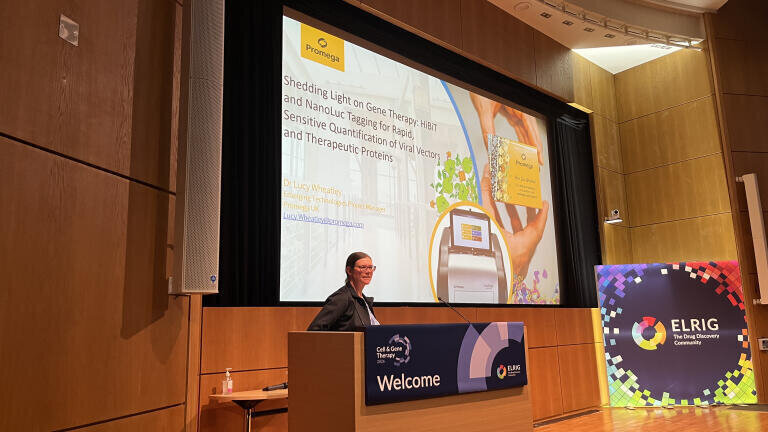
At the ELRIG meeting in March 2026, Dr. Lucy Wheatley of Promega Corporation set out how highly sensitive luminescent assay technologies have begun to improve the evaluation of adeno-associated virus vectors, from transduction and serotype selection to neutralising antibody detection, payload tracking, potency assessment and manufacturing control
Analytical tools with higher sensitivity could help to resolve some of the most persistent practical problems in viral gene delivery research, according to Dr. Lucy Wheatley, emerging technologies project manager at Promega Corporation, presenting at the ELRIG meeting in March 2026 at the Hinxton Hall Conference Centre on the Wellcome Genome Campus in the UK.
Wheatley’s presentation focused on assay technologies for adeno-associated virus (AAV) development and testing, alongside examining how luminescent reporter and complementation systems can support work across the gene delivery pipeline. Rather than treat assay development as a secondary technical concern, the talk argued that measurement itself has become a decisive factor in vector research, translational development and manufacturing quality control. The central issue she detailed was that if a system cannot detect weak but biologically meaningful signals, it becomes much harder to either compare vectors accurately, identify the best capsid, assess immune interference or judge whether a product remains potent and stable.
She placed particular emphasis on next-generation luciferase-based reporter systems which she described as smaller, brighter and more sensitive than older reporter formats. That combination matters because viral gene delivery experiments often operate at the limits of detection. In many cases, transduction efficiency may be low, target material may be scarce or background noise may obscure early biological effects. A brighter reporter system can therefore reveal differences that would otherwise remain hidden. It can also widen dynamic range, improve confidence in weak signals and reduce the risk that subtle but important differences between vector candidates will go unnoticed.
The talk framed this challenge around three practical questions that continue to shape AAV development:
Wheatley’s case was that a sufficiently sensitive reporter toolbox can help researchers answer all three questions within a flexible experimental framework.
In her discussion of transduction and infectivity, she outlined how reporter viruses can enable researchers to compare vector performance across different cell types and assay conditions over relatively short incubation periods. Cells can be exposed to viral constructs, left to express the reporter and then analysed for signal intensity. This readout allows investigators to examine dose response, compare multiplicity of infection and assess relative expression across vector designs.
As Wheatley presented it, higher viral input produced stronger reporter expression which in turn allowed transduction efficiency to map quantitatively rather than rest on crude qualitative impressions. That point is important in gene therapy development, where differences in delivery efficiency can influence both efficacy and safety. And also, where assay precision can guide decisions long before a candidate reaches in vivo evaluation.
She then turned to serotype and tropism selection, an area in which AAV development often depends on careful comparison among candidate capsids. Different serotypes can behave very differently in different cell systems, tissues and disease settings, so vector selection rarely allows a universal answer. Wheatley showed how the same reporter strategy can help to discriminate among a pool of variants by producing clearer signal differences between candidates.
In the examples she cited, some AAV serotypes gave particularly bright expression in specific settings which suggested that assay sensitivity can support more evidence-based capsid selection. Once researchers identify a promising vector, the same system can then track expression over time, allowing them to follow onset, persistence and change in signal across several days after transduction.
This time-course element matters because gene delivery is not only about whether expression occurs, but also about when it begins, how strongly it rises and whether it remains durable. A sensitive reporter therefore serves not simply as a marker of entry but as a tool to characterise the kinetics of expression. In a development setting, that can help teams distinguish among vectors that may appear similar at a single time point and yet perform differently across a longer interval.
Another major part of the presentation addressed neutralising antibody assays which remain especially relevant in AAV development because pre-existing acquired viral immunity in human populations can limit the usefulness of particular capsids. Wheatley described a workflow in which viral particles are first incubated with human serum and are then added to permissive cells. If neutralising antibodies are present, they block viral entry or function and reporter expression falls. If such antibodies are absent, the virus retains activity and the reporter signal remains high. This creates a practical means to estimate the neutralising capacity of serum samples and to generate neutralisation curves across dilution series.
Here again, assay sensitivity was central to her argument. A brighter reporter increases the useful assay window and allows clearer separation between inhibited and uninhibited conditions. Even where sample volume is limited or the neutralising response is modest, the signal may remain strong enough to reveal the inhibition profile. That has obvious implications for donor screening and for the broader problem of patient stratification in gene therapy. If pre-existing immunity can be measured more reliably, developers may gain a better basis on which to choose capsids, interpret variable results and select suitable populations for further study.
Wheatley also described how this type of assay can scale into panel-based analysis. By testing multiple serum samples against one or more viral constructs, researchers can visualise a continuum that ranges from complete neutralisation to little or no neutralising activity. Such panel data could help teams identify which capsids are most vulnerable to human immunity and what varieties may offer greater resilience in translational settings. Within the presentation, this stood out as one of the clearest examples of how improved sensitivity can convert an abstract analytical gain into a concrete development advantage.
Wheatley then spoke about how a split-luciferase complementation strategy built around a small peptide tag and a larger complementary luciferase fragment already expressed in target cells with the system showing an elegant logic. One component travels with the viral payload while the other waits in the recipient cell. Only when successful delivery places the two parts together does luminescence appear. This means the assay can indicate not merely that virus is present somewhere in the system but that productive delivery has taken place in the relevant cellular compartment.
She referred to published work that illustrated this principle. Signal appeared only when both components were present while controls that lacked either the tagged viral element or the complementary cellular partner failed to generate measurable luminescence. That selectivity reduces interpretive ambiguity which is especially valuable in gene delivery studies where background signal, extracellular material or non-productive uptake can otherwise complicate analysis.
Wheatley explained that this approach has also been used in vivo. In the example discussed, tumour-bearing mice expressed the larger luciferase component which allowed researchers to track the accumulation and persistence of signal after administration of a tagged viral construct. The resulting luminescence provided a temporal view of biodistribution and localisation in a living system. Treated animals showed signal emergence and persistence, while controls without the complementary system did not show the same response. That distinction illustrated how complementation assays can help researchers move beyond simple end-point measurements and begin to examine delivery behaviour across time in intact biological settings.
She developed this point further with a case in which the tag was fused to a biologically active protein – a T-cell engager. The goal was to follow not only where the protein went, but also how rapidly it moved from the injection site into systemic circulation. In the example she described, direct protein administration produced a strong early local signal that then fell as the material cleared from the site and appeared in serum. Her broader conclusion was that – without a highly sensitive complementation system – such delivery dynamics would be much harder to detect and quantify. Viral delivery, by contrast, may offer a means to sustain or localise expression in ways that direct protein administration cannot easily achieve.
In her final segment, Wheatley shifted attention from discovery and translational biology to manufacturing and functional potency. She described luminescent immunoassays that use paired antibodies directed against different epitopes on the same analyte. Each antibody would carry a fragment of a reporter enzyme. When both antibodies bind to their target, the fragments come together and reconstitute enzymatic activity, which produces light. The appeal of this format lies not only in sensitivity but also in simplicity. It is a homogeneous assay, requiring no wash steps and can offer wide dynamic range. In manufacturing settings, such properties could simplify quantification, reduce manual handling and support faster analytical workflows than more conventional immunoassay formats.
Wheatley also discussed potency testing, particularly for chimeric antigen receptor ( CAR) delivery. She described an assay based on engineered T-cell reporter cells that respond to immune synapse formation by activating a luminescent pathway. In the workflow she outlined, cells are exposed to a viral vector that encodes the CAR construct. After expression occurs, target cells are introduced. If the delivered CAR is functional, immune engagement follows and the reporter system emits light. In this way, luminescence serves as a proxy for biological potency rather than merely as evidence that vector material is present.
That distinction is particularly important in advanced therapy development. For developers and manufacturers, the key question is often not whether a vector exists in the vial but whether it still performs its intended biological function. Wheatley argued that the same assay approach can act as a stability-indicating test. She referred to data in which viral samples exposed to stress for increasing periods showed weaker and altered responses, consistent with declining functional activity. In a quality control context, such a readout could help to show whether a product remains fit for purpose across storage or handling conditions.
Taken together, the presentation made a coherent case that sensitive luminescent assays have begun to offer practical advantages across the AAV development pathway. From transduction screening and capsid comparison to neutralising antibody detection, payload tracking, potency measurement and manufacturing analytics, Wheatley’s central message was that better analytical sensitivity can lead directly to better development decisions. The scientific and commercial value of gene delivery platforms will depend not only on vector design but also on the ability to measure performance accurately, the interpretation of weak signals with confidence and the detection of functional loss before it becomes a downstream problem.
ILM 51.6 Sept 2026



 Product directory
















.jpg)

.jpg)









.jpg)
