Research news
Researchers at Texas A&M Health and collaborators have developed engineered CRAC channel inhibitory binders that can selectively disrupt STIM1–Orai1 signalling, with potential implications for rare calcium-channel disorders
Calcium is widely recognised for its role in bone and tooth health but its influence extends far beyond structural biology. Within cells, calcium acts as one of the body’s most important molecular messengers. It helps to regulate muscle contraction, neural activity, immune-cell activation and many other physiological processes. Because cells depend on calcium signals to decide when to respond, how strongly to respond and how long that response should last, calcium movement must be controlled with exceptional precision.
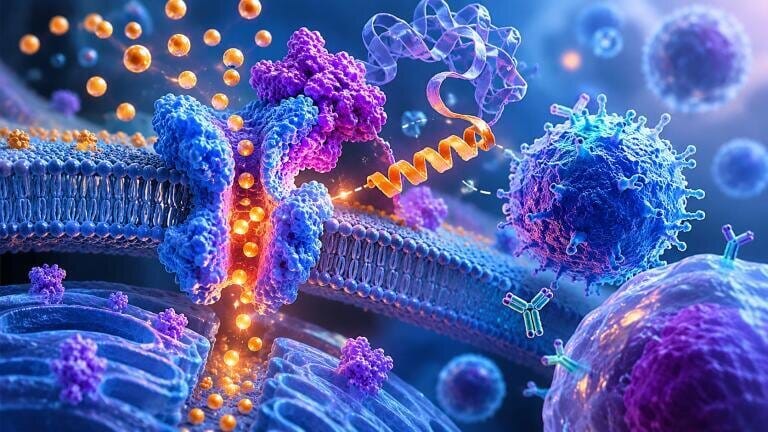
One of the major calcium-signalling pathways in human cells is store-operated calcium entry (SOCE). This process allows a cell to replenish and use calcium when internal stores become depleted. The endoplasmic reticulum, a specialised internal membrane network that also acts as a major calcium reservoir, serves as the cellular sensor in this pathway. When calcium levels inside the endoplasmic reticulum fall, stromal interaction molecule 1 (STIM1) detects this depletion and activates Orai channels –a highly selective calcium ion channel in the cell membrane which allows Ca²⁺ to enter the cell when calcium stores inside the endoplasmic reticulum are depleted – in the plasma membrane. Orai1 forms the core of the calcium release-activated calcium channel (CRAC), to allow calcium outside the cell to enter the cytosol and trigger downstream signalling.
The control of this pathway has been the focus of research led by Dr. Yubin Zhou, director of the Center for Translational Cancer Research at the Texas A&M Health Institute of Biosciences and Technology, Houston, Texas, USA and is professor in the Texas A&M Naresh K. Vashisht College of Medicine.
In collaboration with Dr. Guolin Ma, MD Anderson, also in Houston, and Dr. Qing Deng of Purdue University, in West Lafayette, Indiana, USA, Zhou’s team has published its study describing engineered CRAC channel inhibitory binders – or CRABs. These binders were designed to interfere selectively with communication between STIM1 and Orai1 and to reduce calcium entry through CRAC channels.
“Calcium signals are essential for cells to function,” said Dr. Tien-Hung Lan, a research project scientist in Zhou’s laboratory and co-author of the study.
“There are several routes by which calcium can enter the cell, and CRAC channels are one of the major pathways. They are especially important in immune cells, including T cells,” he said.
T cells rely on CRAC channels to sustain calcium signals that activate transcription factors such as nuclear factor of activated T cells. These transcription factors help to drive immune-cell activation and cytokine production. When the pathway fails, immune cells may not respond properly. When it becomes excessive or chronically active, it can contribute to disease.
Previous work has shown that CRAC channel activity depends mainly on two core components. Orai1 forms the calcium-selective channel in the plasma membrane, while STIM1, located in the endoplasmic reticulum membrane, senses depletion of internal calcium stores. Once activated, STIM1 moves to contact sites between the endoplasmic reticulum and plasma membrane, where it binds Orai1, opens the channel and permits calcium influx.
“There have been ongoing efforts in the community to understand how STIM and Orai proteins interact,” said Lan.
“While studying this interface, we realised that an Orai-derived peptide could be used as a decoy to compete for STIM1 binding and prevent the endogenous channel from opening.”
The strategy relies on competitive inhibition, in which one molecule binds to a protein at a site intended for another molecule. Rather than use a conventional channel blocker, the research team engineered peptide binders to prevent STIM1 from engaging Orai channels. This reduced calcium influx and downstream signalling at an earlier regulatory point in the pathway.
To test whether the peptide binders could counteract pathological CRAC-channel activation, Zhou’s laboratory used a zebrafish model of Stormorken syndrome – which is a rare multisystem disorder linked to excessive CRAC-channel activity. Patients may experience thrombocytopenia – meaning a low platelet count – as well as bleeding problems, muscle weakness or cramping, miosis – which causes abnormally constricted pupils – and other symptoms.
“With the gain-of-function mutations there will be consequences,” said Zhou.
In the study, the researchers showed that their engineered binders – named ‘CRABs’ for CRAC channel inhibitory binders – specifically targeted the CRAC channel pathway and helped to restore production of thrombocyte progenitors. These precursor cells are needed to support normal clotting and prevent abnormal bleeding.
The findings suggest that CRABs could offer a more precise way to moderate calcium signalling than broad inhibition of calcium entry. This distinction matters because calcium signals are essential to normal physiology. A therapeutic strategy that blocks calcium influx indiscriminately could disrupt healthy cellular function, while a tunable system could make it possible to reduce excessive signalling without permanently silencing the pathway.
Zhou’s laboratory is now considering how the platform could be adapted for broader applications, including future strategies to improve cellular immunotherapies. Chimeric antigen receptor T cell therapy (CAR T) cell therapy has transformed treatment for some blood cancers, but safety, persistence and durability remain major challenges. Excessive or chronic calcium signalling can contribute to tonic signalling, T cell exhaustion and cytokine production, all of which may limit therapeutic performance or increase toxicity.
“There are significant side effects and durability challenges in CAR T cell therapy, and calcium signalling is one pathway that can contribute to overactivation or exhaustion,” said Lan.
“If we can tune this pathway rather than permanently shut it off, we may be able to expand the therapeutic window and improve the performance of engineered immune cells,” he added.
For patients with CRAC-channel-related disorders, the study provides a proof of concept for more precise control of a disease-relevant signalling pathway. For cancer patients treated with cellular immunotherapy, the work points towards a future in which engineered immune cells could include built-in molecular controls to adjust their activity. Such control could, in principle, help to balance potency against safety.
The approach also fits a wider movement towards precision medicine, in which disease mechanisms are not only identified but also modulated with targeted molecular tools. In this case, CRABs offer genetically encoded, tunable control of a central calcium-entry pathway, potentially through chemical or light-responsive systems.
“The long-term vision is to create molecular tools that can adjust cell signalling with precision,” said Zhou.
“CRABs give us a way to place an adjustable brake on T cell activity, which could be useful for studying disease mechanisms and, eventually, for designing safer and more controllable immune cell-based therapies,” he added.
For further reading please visit: 10.1038/s41467-026-71769-2
ILM 51.6 Sept 2026



 Product directory



















,-photo-Karin-Allander.jpg)






.jpg)
