Research news
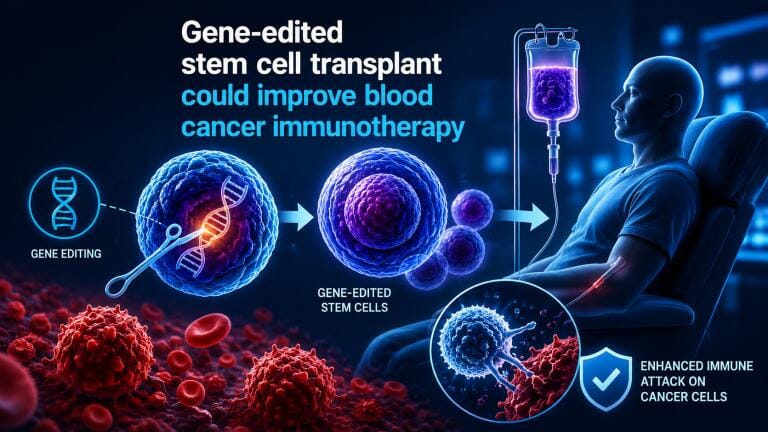
A multicentre clinical trial led by Washington University School of Medicine in St Louis has shown that donor stem cells edited to remove CD33 can engraft successfully in patients with high-risk acute myeloid leukaemia or myelodysplastic syndrome, with results that could support safer CD33-targeted immunotherapies after transplant
A clinical trial led by researchers at Washington University School of Medicine (WUSM) in St Louis, USA, has shown that a gene-edited stem cell transplant could help to reduce toxic side effects and improve the potential effectiveness of post-transplant therapies for aggressive blood cancers.
Stem cell transplantation is often the only treatment with curative potential for highly aggressive forms of blood cancer, including acute myeloid leukaemia and myelodysplastic syndrome. However, even after transplant, these diseases often relapse. The novel study has examined whether donor stem cells edited to remove a surface protein called CD33 could make it possible to use CD33-targeted therapies after transplant without also damaging healthy donor-derived blood cells.
The study was conducted at Siteman Cancer Center, based at Barnes-Jewish Hospital and WUSM in St Louis, together with 14 other sites across the USA and in Canada.
According to Dr. John F. DiPersio, the study’s corresponding author and the Virginia E. and ‘Sam J. Golman Professor of Medicine’ at WUSM, the research could help to address a persistent problem in blood cancer treatment. Chimeric antigen receptor T cell therapy – CAR-T cell therapy – has transformed care for some aggressive blood cancers but it has not worked well against all malignancies, including acute myeloid leukaemia and myelodysplastic syndrome.
DiPersio, who treats patients at Siteman Cancer Center and is a research member there, said myeloid cancers such as acute myeloid leukaemia and myelodysplastic syndrome posed a particular challenge because the target proteins present on cancer cells were also found on healthy myeloid cells. These healthy cells include the donor stem cells used for therapeutic transplantation. As a result, an immunotherapy designed to attack the cancer can also destroy the healthy blood-forming cells that a patient needs after transplant.
This off-target effect can cause serious toxicity, including a dangerous inflammatory cascade. It could also weaken the anti-cancer effect because many CAR-T cells may attack healthy cells rather than malignant cells which could leave cancer cells untouched.
The underlying concept was first described by Dr. Miriam Y. Kim, now an assistant professor of medicine at WUSM. Kim began the research as a postdoctoral researcher at the University of Pennsylvania, USA, and continued the work in the DiPersio laboratory before she became an independent investigator in the Division of Oncology at WUSM.
In the clinical trial, patients with acute myeloid leukaemia and myelodysplastic syndrome received donor stem cells from which CD33 had been removed. The aim was to create a transplant platform in which future CD33-targeted immunotherapies could attack the cancer while leaving healthy transplanted cells unharmed.
“We are encouraged by the results of this study showing that a CD33-deleted stem cell transplant looks very similar to the outcomes of standard stem cell transplantation,” said DiPersio, who also directs WUSM’s Center for Gene and Cellular Immunotherapy.
“In the future, we are hopeful we will be able to combine this with CD33-targeted immunotherapies, such as CAR-T cells, and improve treatment options for patients with these very aggressive blood cancers,” he added.
DiPersio and his collaborators have also published a single case study of a patient with high-risk acute myeloid leukaemia who received a CD33-deleted stem cell transplant and later, after relapse, received CD33-targeted CAR-T cell therapy. The CAR-T cells came from the same donor who had provided the stem cell transplant. The patient, who had one of the most aggressive forms of acute myeloid leukaemia, achieved complete remission and remained cancer-free more than one year after the CAR-T cell therapy.
The patient also recovered normal blood cell production, with all blood cells lacking CD33. This provided evidence that the genetically engineered donor stem cells had established themselves in the bone marrow. DiPersio was the senior author of that case study published in JCO Precision Oncology, October 2025.
CD33 is an attractive target for this strategy because it is present only on blood-forming cells and not in other tissues. Evidence also suggests that CD33 is not required for normal blood stem cell function because people born without CD33 appear to have no obvious health problems. In principle, after successful transplantation with CD33-deleted donor cells, any remaining cells in the body that still carry CD33 should be cancer cells. A CD33-targeted CAR-T cell therapy, or another CD33-directed immunotherapy, could then kill the cancer while sparing healthy donor-derived stem cells.
The phase 1/2 multicentre clinical trial included 30 adult patients with acute myeloid leukaemia or myelodysplastic syndrome who were considered at high risk of relapse. Each patient received a stem cell transplant in which CD33 had been removed from donor cells by CRISPR gene editing before the transplant procedure. The CD33-deleted stem cell product, tremtelectogene empogeditemcel – also known as trem-cel – was made by Vor Biopharma, the study’s sponsor.
As a proof of concept, patients also received a CD33-targeted maintenance therapy after transplant. This therapy, gemtuzumab ozogamicin, is not a CAR-T cell therapy. It is an engineered antibody that recognises CD33 and delivers an anti-cancer drug to CD33-positive cells. Gemtuzumab ozogamicin has been approved by the US Food and Drug Administration to treat CD33-positive acute myeloid leukaemia and has been assessed in clinical trials for CD33-positive myelodysplastic syndrome.
Although gemtuzumab ozogamicin can help to prevent relapse, its use has been limited by toxicity. The drug can damage the liver and reduce blood cell counts, including white blood cells, red blood cells and platelets. Such effects can be dangerous after standard stem cell transplantation, when patients are already vulnerable to infection, bleeding and other transplant-related complications.
In the trial, all patients achieved engraftment of the transplanted stem cells by day 28. This meant that the cells had reached the bone marrow and had begun to produce blood cells. Some patients achieved this milestone earlier, and platelet production returned by day 16 on average. These timelines were comparable with those observed after standard stem cell transplantation.
Mean survival was just more than 14 months. Nineteen patients received at least one cycle of the antibody maintenance therapy as part of a dose-escalation protocol, and the researchers were able to establish a recommended dose. Across all dose levels, patients maintained blood cell counts, which suggested that the gene-edited stem cell transplant protected them from the dangerously low blood cell counts usually associated with this maintenance therapy after a standard stem cell transplant.
Side effects during treatment were similar to those seen with conventional transplants. They included anaemia, low platelet counts, fever, infection and graft-versus-host disease – a complication in which donor cells attack the patient’s healthy tissues.
Seven patients died during the study. Four deaths were due to cancer progression, while three were attributed to transplant-related causes, including kidney failure, liver toxicity and sepsis.
DiPersio said the study had provided a foundation for the development of paired therapeutic strategies that combine CD33-deleted stem cell transplantation with CD33-targeted immunotherapy. Such an approach could allow clinicians to attack residual cancer cells after transplant while avoiding the destruction of healthy donor-derived blood cells.
Although further research will be needed to confirm safety and efficacy in larger patient groups, the trial has provided early clinical evidence that gene-edited donor stem cells can support a more selective form of post-transplant treatment for aggressive blood cancers. For patients with acute myeloid leukaemia and myelodysplastic syndrome at high risk of relapse, the approach could help to extend the reach of immunotherapy into diseases that have so far proved difficult to treat with CAR-T cell strategies.
For further reading please visit: 10.1038/s41591-026-04362-1
ILM 51.6 Sept 2026



 Product directory



















,-photo-Karin-Allander.jpg)








.jpg)
