Research news
Researchers have developed potent inhibitors against a key Plasmodium falciparumenzyme offering a molecular blueprint for future antimalarial drug discovery
A research team drawn from the universities of Bath and Leeds has identified a promising potential target for antimalarial drug discovery, after they developed inhibitors against an enzyme used by the malaria parasite to process human haemoglobin.
The findings have provided a molecular framework to support the design of more effective antimalarial drugs with fewer side effects. The work focused on aminopeptidase P from Plasmodium falciparum, the parasite responsible for the most severe form of malaria in humans.
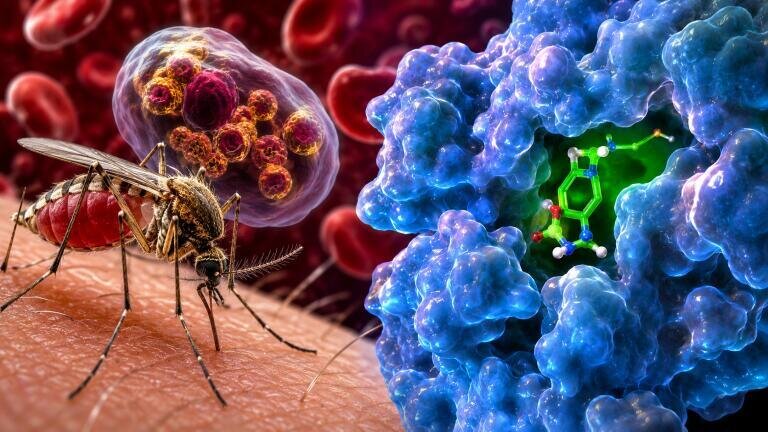
Malaria is a life-threatening disease caused by parasites transmitted to humans through the bites of infected mosquitoes. It causes an estimated 282 million cases and 610,000 deaths worldwide each year. Although effective treatments are available, side effects remain a concern and drug resistance has continued to increase which has created an urgent need for novel therapeutic approaches.
Aminopeptidase P plays an important role in the parasite’s ability to break down haemoglobin from the human host. This process releases amino acids that the parasite needs to grow and replicate inside red blood cells. By blocking this enzyme, researchers aim to disrupt an essential metabolic pathway in the parasite without damaging human cells.
The Bath-Leeds team combined biological and chemical expertise to design a class of inhibitors based on apstatin, an existing compound known to target the enzyme. The novel inhibitors were designed to bind more strongly to the parasite enzyme than apstatin itself.
The researchers used X-ray crystallography to visualise how the inhibitors interacted with aminopeptidase P at the molecular level. In this method, X-rays are passed through crystals containing the enzyme bound to each inhibitor which allows scientists to determine the three-dimensional arrangement of atoms within the complex.
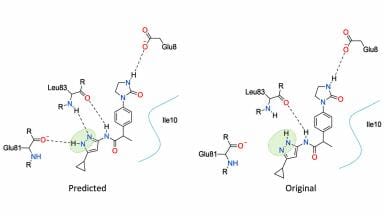
The resulting structures showed that the inhibitors fitted into the enzyme’s active site, the pocket where haemoglobin fragments would normally bind and be broken down. By occupying this space, the inhibitors blocked the fragments from entering the active site and reduced the enzyme’s ability to function.
The team showed that the inhibitors not only bound more strongly than apstatin in biochemical assays but could also kill the parasite in vitro. This finding has made them promising candidates for further drug development, although the researchers noted that additional optimisation would be needed before they could be considered viable treatments.
“Our work shows how subtle changes in inhibitor design can transform weak compounds into highly potent and selective molecules,” said Professor K. Ravi Acharya, from the University of Bath’s Department of Life Sciences and corresponding author of the study.
“Importantly, we were able to visualise the enzyme with these inhibitors bound to it, allowing us to directly observe the molecular interactions that drive their activity,” he said.
The co-authors at the University of Leeds included chemist Professor Richard Foster and biologists Professor Elwyn Isaac and Professor Glenn McConkey.
“This is an important step forward in understanding how to target essential metabolic pathways in malaria parasites,” said Professor Foster.
“By defining the structural rules for selectivity, we can now design inhibitors that are both more effective and safer,” he added.
Despite the high potency of the inhibitors in biochemical assays, the researchers also identified challenges linked to cellular uptake. In particular, the compounds will need to be optimised for drug-like properties such as permeability, which determines whether they can enter parasite-infected cells efficiently enough to have a therapeutic effect.
“Malaria remains a major global health challenge, with growing resistance to existing treatments posing an increasing threat,” said Professor Isaac.
“By providing a detailed molecular blueprint for inhibitor design, our collaborative study lays the foundation for a new generation of drugs targeting essential parasite enzymes,” he concluded.
For further reading please visit: 10.1016/j.jbc.2026.111372
ILM 51.6 Sept 2026



 Product directory


















,-photo-Karin-Allander.jpg)








.jpg)
