Research news
Flexible, low-cost artificial neurons have demonstrated direct communication with living brain cells, offering a route to energy-efficient artificial intelligence hardware and next-generation neuroprosthetics
Engineers at Northwestern University, Evanston, Illinois, USA, have developed artificial neurons capable of direct functional interaction with living brain tissue, a result that has marked a notable step towards electronics that can communicate with the nervous system and reduce the energy demands of artificial intelligence (AI) systems.
In a recent study the research team reported that flexible, printable devices generated electrical signals sufficiently realistic to activate biological neurons. When the devices were applied to slices of mouse brain tissue, they triggered neural responses that closely matched those produced by natural neuronal activity, which indicated a high degree of biocompatibility.
The findings have extended the frontier of brain–machine interfacing, with implications for neuroprosthetic technologies designed to restore sensory or motor function, including systems for hearing, vision and movement. At the same time, the work has supported efforts to design computing architectures that emulate the efficiency of biological neural networks, which remain markedly more energy-efficient than conventional silicon-based systems.
“The world we live in today is dominated by AI,” said Dr. Mark C. Hersam, who led the study.
“The way you make AI smarter is to train it on more and more data. This data-intensive training leads to a massive power-consumption problem. Therefore, we have to come up with more efficient hardware to handle big data and AI.
“Because the brain is five orders of magnitude more energy efficient than a digital computer, it makes sense to look to the brain for inspiration for next-generation computing,” he added.
As computational workloads have increased in scale and complexity, conventional processors have relied on ever greater numbers of identical transistors embedded within rigid, two-dimensional silicon substrates. These components operate uniformly and remain fixed after fabrication. By contrast, biological neural systems comprise diverse, specialised cell types arranged in dynamic, three-dimensional networks that continually adapt through the formation and modification of synaptic connections.
“Silicon achieves complexity by having billions of identical devices,” Hersam said.
“Everything is the same, rigid and fixed once it’s fabricated. The brain is the opposite. It’s heterogeneous, dynamic and three-dimensional. To move in that direction, we need novel materials and novel ways to build electronics,” he said.
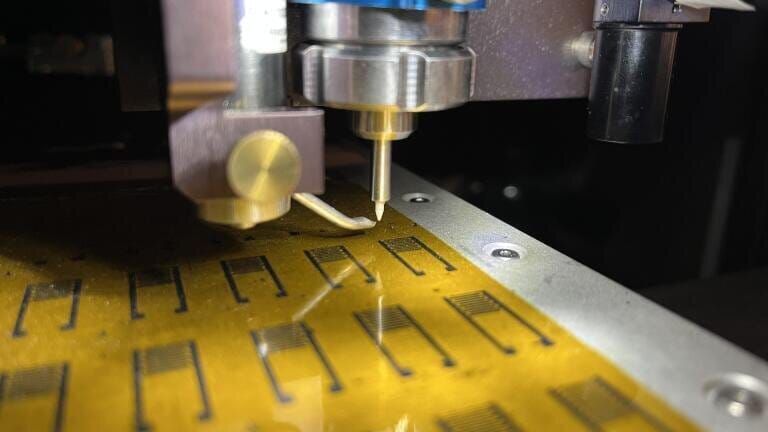
To approximate this biological complexity, the researchers engineered artificial neurons from soft, printable materials designed to replicate key aspects of neuronal structure and signalling. Central to the approach was the formulation of electronic inks containing nanoscale flakes of molybdenum disulfide – a semiconductor material – and graphene, which functions as a conductor. Using aerosol jet printing, the team deposited these inks onto flexible polymer substrates to construct the devices.
Earlier efforts in the field have typically removed stabilising polymers after fabrication, as they were thought to impede electrical conduction. In contrast, the Northwestern group has exploited partial polymer decomposition as a functional feature. Controlled degradation during operation has produced spatially inhomogeneous conductive pathways, which have confined electrical current to narrow regions and generated sharp, neuron-like electrical responses.
“Instead of fully removing the polymer, we partially decompose it,” Hersam said.
“Then, when we pass current through the device, we drive further decomposition of the polymer. This decomposition occurs in a spatially inhomogeneous manner, leading to formation of a conductive filament, such that all the current is constricted into a narrow region in space,” he said.
This mechanism has enabled the artificial neurons to produce a diverse repertoire of electrical signalling patterns, including isolated spikes, sustained firing and bursting behaviour, which more closely resemble the dynamics of biological neurons than earlier models. Such diversity allows each unit to encode more information, which in turn could reduce the number of components required in neuromorphic computing systems and improve overall energy efficiency.
To evaluate functional compatibility with living systems, the team collaborated with Dr. Indira M. Raman, whose laboratory applied the artificial signals to slices of mouse cerebellum. The induced voltage spikes matched critical biological parameters, including timing and waveform characteristics, and reliably activated neural circuits in patterns comparable to endogenous activity.
“Other labs have tried to make artificial neurons with organic materials, and they spiked too slowly,” Hersam said.
“Or they used metal oxides, which are too fast. We are within a temporal range that was not previously demonstrated for artificial neurons. You can see the living neurons respond to our artificial neuron.
“So, we’ve demonstrated signals that are not only the right timescale but also the right spike shape to interact directly with living neurons,” he added.
The work has also addressed a growing concern within the technology sector, where the rapid expansion of AI has driven escalating energy consumption. Data centres designed to support large-scale machine learning have required substantial power inputs and cooling resources, which has raised questions about long-term scalability and sustainability.
“To meet the energy demands of AI, technology companies are building gigawatt data centres powered by dedicated nuclear power plants,” Hersam said.
“It is evident that this massive power consumption will limit further scaling of computing since it’s hard to imagine a next-generation data centre requiring 100 nuclear power plants.
“The other issue is that when you’re dissipating gigawatts of power, there’s a lot of heat. Because data centres are cooled with water, AI is putting severe stress on the water supply. However you look at it, we need to come up with more energy-efficient hardware for AI,” he concluded.
For further reading please visit: 10.1038/s41565-026-02149-6
ILM 51.6 Sept 2026



 Product directory




















,-photo-Karin-Allander.jpg)








.jpg)
