Research news
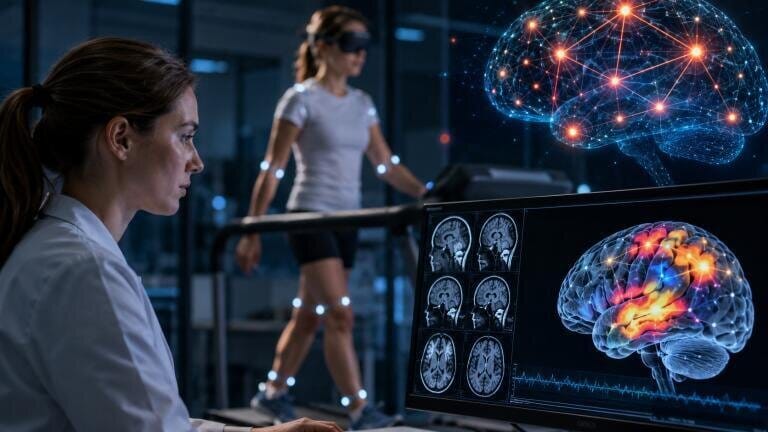
Recent research has shown how the brain may compensate for reduced visual input during walking by reinforcing functional connections between motor and frontal brain regions, with potential implications for rehabilitation in people with low vision
Vision provides a critical source of spatial information for human movement, in effect acting as a navigation system that helps the brain to judge position, direction and environmental risk during locomotion. When visual input is reduced, the central nervous system must rely more heavily on other sensory and motor signal inputs to maintain stability of movement and avoid falls. Novel research has now provided further insight into how the brain may adapt to this challenge at a functional network level.
The study examined how simulated visual impairment altered visual pathway activity and brain function after walking in healthy young adults. The researchers used Bangerter™ occlusion foils to reduce visual input and create an experimental model of low-quality vision. They combined this approach with pattern-reversal visual evoked potentials, a technique that measures electrical responses in the brain after visual stimulation and resting-state functional magnetic resonance imaging (MRI) which assesses patterns of spontaneous brain activity and connectivity when a person is not engaged in a specific task.
The results showed that simulated visual impairment significantly reduced the efficiency of signal processing along the visual pathway. This finding confirmed that the occlusion model produced degraded visual input in a stable and measurable way. The researchers then examined how the brain changed after walking under normal vision and under visual occlusion.
Under normal visual conditions, walking was associated with a decrease in the amplitude of low-frequency fluctuations in the right paracentral lobule compared with the resting state. The amplitude of low-frequency fluctuations is used in functional MRI research as an indicator of local spontaneous neural activity. Under visual occlusion, however, activity in this region showed a slight rebound after walking, which the authors interpreted as evidence of adaptive adjustment in local brain function.
The study also found that walking activated functional connectivity across several sensorimotor pathways that support basic locomotion. These included connections involving the bilateral calcarine cortex and middle temporal gyrus, the bilateral supplementary motor area and right cuneus and the bilateral precentral gyrus and right cerebellar lobule VI. Together, these areas contribute to visual processing, movement planning, motor execution and balance-related control.
The most important observation was that visual occlusion further strengthened functional connectivity between the right precentral gyrus and the middle frontal gyrus. The precentral gyrus contains the primary motor cortex, which has a central role in voluntary movement, while the middle frontal gyrus is associated with higher-order control processes, including attention and executive regulation. The enhanced communication between these regions may represent a compensatory mechanism that helps the brain to preserve walking stability when visual information is insufficient.
The findings suggest that the brain may respond to low-quality visual input through a dual strategy: stable activation of core sensorimotor pathways that support locomotion, combined with targeted reinforcement of specific functional connections that help to compensate for visual loss. This interpretation is particularly relevant for people with low vision, who may depend more heavily on non-visual sensory information and adaptive motor control to move safely through their environment.
The researchers suggested that the work could help to guide future rehabilitation strategies for people with visual impairment. In particular, visual-somatosensory multimodal training may offer a way to strengthen key functional connections, including those between the right precentral gyrus and middle frontal gyrus. Such an approach could support more personalised motor rehabilitation programmes that target brain function as well as physical movement.
By linking visual impairment, locomotor control and functional brain adaptation, the study has added to the evidence that rehabilitation for low-vision populations should not focus only on the eyes or on musculoskeletal performance. It should also consider how the brain reorganises sensory and motor information to sustain safe movement.
For further reading please visit: 10.1097/CM9.0000000000004040
ILM 51.6 Sept 2026



 Product directory


















,-photo-Karin-Allander.jpg)






.jpg)
