Research news
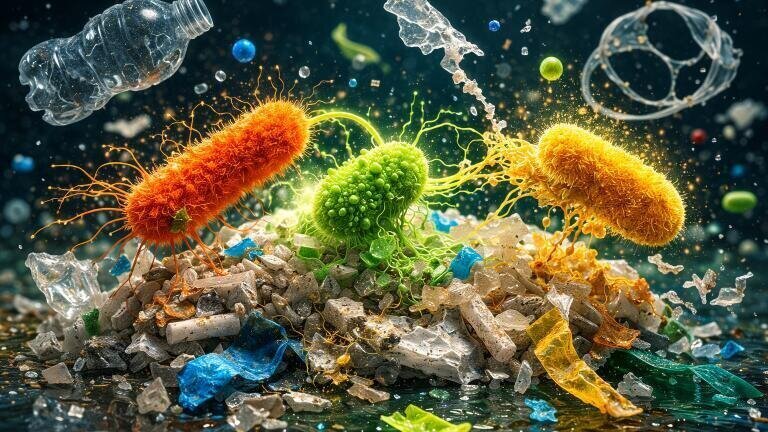
Researchers in Germany have uncovered a cooperative community of three bacterial species capable of breaking down phthalate esters (PAEs), common plastic additives. The consortium’s superpower is microbial cross-feeding, where the metabolic byproducts of one microbe become nutrients for another. This teamwork, never before seen in plastic-degrading bacteria, makes the community more resilient and versatile than individual species working alone.
Plastic pollution now reaches the planet’s most remote corners, from the Mariana Trench to the peaks of Everest. While dozens of plastic-degrading microbes have been discovered over the last 25 years, most digest only a single type of plastic, work slowly, and need controlled lab conditions.
One potential solution is microbial teamwork. Combining species allows bacteria to share tasks, complement each other’s strengths, and maintain activity under changing conditions. Scientists at the Helmholtz Centre for Environmental Research in Leipzig have now identified such a synergistic bacterial consortium capable of digesting PAEs — plasticisers found in packaging, building materials, and personal care products that are linked to hormonal, metabolic, and developmental disorders, and even some cancers. The findings [1] appear in Frontiers in Microbiology.
The discovery came from microbes growing as a biofilm on polyurethane tubing in a bioreactor. Cultured with diethyl phthalate (DEP) as the sole carbon source, a stable consortium emerged that could thrive in DEP concentrations up to 888 mg/L, fully consuming it within 24 hours at 30°C.
DNA sequencing revealed three bacterial species: one from the Pseudomonas putida group, one from Pseudomonas fluorescens, and a previously unidentified Microbacterium species. Alone, none could digest PAEs; together, they formed a cooperative network. Key to their efficiency is cross-feeding, where metabolic byproducts from one microbe feed another. The intermediates — monoethyl phthalate and phthalate — are themselves PAEs, and proteomic analysis revealed enzymes previously unknown to science.
Beyond DEP, the consortium could also metabolise dimethyl, dipropyl, and dibutyl phthalates, showing broad versatility and promising potential for biotechnological and environmental applications. The bacteria likely evolved this capacity under pressure from persistent PAE pollution, developing specialised enzymes capable of breaking down these plasticisers more efficiently.
The consortium does not yet process plastics with non-ester bonds, such as polyethylene or polypropylene. The next step is to test it in wastewater containing microplastics, assessing its potential for bioaugmentation and real-world environmental cleanup.
“Here we show the degradation of various phthalate esters (PAEs) through the cooperative activity of several bacterial strains,” said Dr Christian Eberlein, postdoctoral researcher at the Helmholtz Centre for Environmental Research in Leipzig and corresponding author of the study.
“The next step will be to test our consortium in actual wastewater samples containing microplastics, to assess its ability to remove PAEs,” added Dr Hermann Heipieper, Senior Scientist at the Helmholtz Centre and senior author. “Introducing these bacteria into polluted natural environments could potentially help reduce PAE contamination in real-world settings.”
More information online
ILM 51.6 Sept 2026



 Product directory


















,-photo-Karin-Allander.jpg)



.jpg)
