
Research news
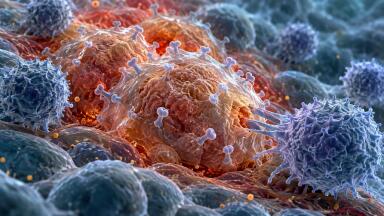
Scientists at The Wistar Institute and ChristianaCare’s Helen F. Graham Cancer Center & Research Institute have uncovered a previously unknown mechanism that fuels pancreatic cancer growth, revealing a potential new therapeutic target.
The study [1], published in the Proceedings of the National Academy of Sciences, shows that damaged mitochondria within cancer cells can leak double-stranded RNA into the cell, triggering an inflammatory response that is hijacked by tumours to support growth and survival.
Researchers found that pancreatic cancer cells become highly dependent on this inflammation, meaning that blocking the signalling pathway leads to cancer cell death while sparing healthy cells. In preclinical models, inhibition of the TLR3/TRAF6 pathway halted tumour growth, highlighting a potential therapeutic vulnerability.
Senior author Dario Altieri, M.D., President and CEO of The Wistar Institute, said the finding reveals an entirely new role for mitochondrial dysfunction in cancer biology. “It’s been known that mitochondria could release double-stranded RNA and generate inflammation, but not in cancer, and not as a cancer driver,” he explained.
The study identifies a key structural defect in tumour mitochondria, where loss of the protein Mic60 leaves the organelle membrane compromised. These defective ‘ghost mitochondria’ leak double-stranded RNA, activating innate immune sensors as if the cell were infected.
This signal is detected by TLR3 and TRAF6 proteins, which trigger a strong inflammatory cascade that cancer cells exploit for survival and proliferation. Researchers describe this as a form of ‘inflammatory addiction’, where tumours become dependent on the very process they initiate.
Altieri noted that blocking this pathway selectively killed cancer cells in laboratory models, while healthy cells were unaffected, suggesting a promising therapeutic window.
The team now aims to understand how mitochondrial membrane damage arises and whether this inflammatory cascade can be safely targeted in patients with pancreatic cancer, a disease that remains highly resistant to treatment and associated with poor outcomes.
More information online
ILM 51.6 Sept 2026



 Product directory















,-photo-Karin-Allander.jpg)



.jpg)
