-and-Professor-Martin-Weides.jpg)
Research news
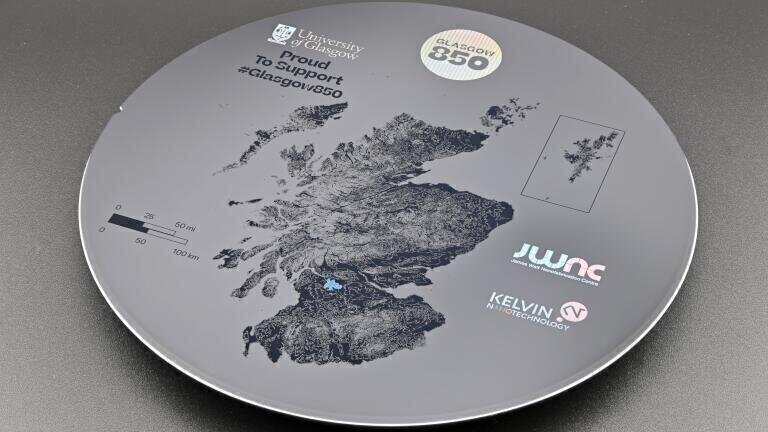
Researchers at the University of Glasgow have marked the city’s 850th anniversary with an extraordinary nanoscale tribute: a detailed map of Scotland etched onto silicon. The River Clyde in the map measures just 50 microns wide — the width of a human hair.
The shimmering artwork, created at the University’s £35 million James Watt Nanofabrication Centre (JWNC), was made using the same precision electron-beam lithography and plasma etching tools normally used to build semiconductor and quantum devices.
Each contour of the Scottish landscape was drawn using a beam of electrons just nanometres wide — effectively, the world’s sharpest pencil. The river glints with holographic highlights that change colour as the wafer is tilted, created by structures smaller than the wavelength of light.
The project brought together specialists from the JWNC and its commercial partner Kelvin Nanotechnology, both central to Scotland’s Critical Technologies Supercluster. Together, these facilities underpin national efforts to advance microfabrication and secure the UK’s sovereign capability in semiconductors, photonics, and quantum components.
Dr Paul Reynolds, Senior Research Engineer at the James Watt Nanofabrication Centre, who led the project, said the piece celebrates both Glasgow’s heritage and its future:
“We wanted to do something that captures the city’s creativity and precision engineering spirit. I don’t think there’s anywhere else in the UK with the expertise and tools to make something like this.”
The JWNC produces components that power modern technologies from cloud computing to artificial intelligence, and it will soon expand its capabilities with a new Critical Technologies Nanofabrication Facility. The planned site will bridge the gap between lab-scale innovation and commercial manufacturing, training skilled engineers and strengthening the UK’s high-tech economy.
As Councillor Susan Aitken noted: “This achievement perfectly symbolises Glasgow’s transformation from a traditional manufacturing city into a global hub for precision engineering and innovation.”
More information online
ILM 51.6 Sept 2026



 Product directory




















,-photo-Karin-Allander.jpg)