Research news
Researchers in Japan have reported a solvent-free technique that uses heat and vacuum to convert poorly soluble drugs into more bioavailable amorphous forms, addressing a central bottleneck in modern pharmaceutical development
A substantial proportion of medicines developed today have failed to reach patients for the simple reason that they do not adequately dissolve in water. Despite delivery innovations in drug discovery, the oral route remains the preferred mode of administration because of its convenience, familiarity and patient adherence.
For an orally administered medicine to exert its therapeutic effect its active pharmaceutical ingredient must dissolve into the gastrointestinal fluids before absorption into the bloodstream can occur. When dissolution proceeds too slowly or remains incomplete, bioavailability falls and clinical efficacy may diminish.
This challenge – the pharmaceutical ‘solubility crisis’ – has emerged as one of the most significant constraints on drug development. Estimates suggest that as much as 90% of active compounds currently under investigation exhibit poor aqueous solubility, which places severe limits on formulation options and increases the likelihood of late-stage failure.
One established strategy to improve solubility has focused on modification of the physical state of drug molecules rather than their chemical structure. Most small-molecule drugs exist naturally in a crystalline form, in which molecules occupy a highly ordered and energetically stable lattice that resists dissolution. Conversion to an amorphous form, characterised by molecular disorder and higher free energy, can markedly enhance solubility and dissolution rate. In practice, pharmaceutical scientists have often achieved this conversion by adsorbing drug molecules onto mesoporous silica, a material with a high internal surface area that can inhibit recrystallisation.
Conventionally, this process has relied on the evaporation and condensation method, which requires dissolution of the drug in strong organic solvents before adsorption onto the silica matrix. While effective, this approach introduces health, safety, and environmental concerns, as well as additional manufacturing complexity.
In search of a more sustainable alternative, a research group led by Professor Takehisa Hanawa at the Faculty of Pharmaceutical Sciences, Tokyo University of Science, has investigated an organic solvent-free approach to drug loading. His team explored a sealed heating method that exploits the gas phase rather than liquid solvents.
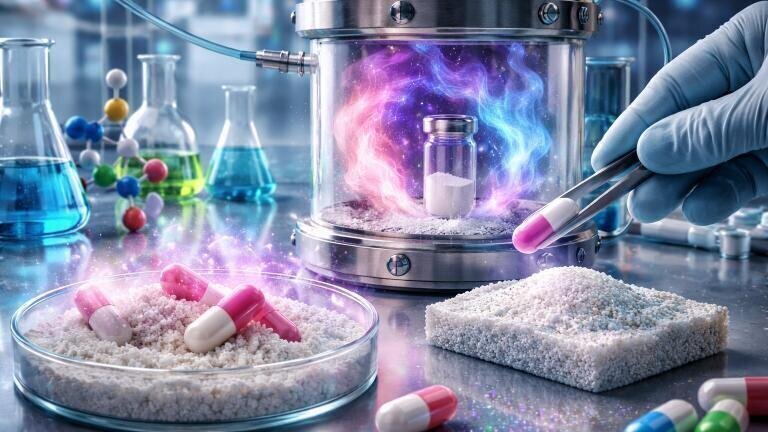
The approach involves placement of a solid powder mixture of mesoporous silica and a drug into a sealed container under vacuum, followed by gentle heating. Under these conditions, drug compounds transitioned directly from solid to gas via sublimation. Once in the gaseous state, drug molecules adsorbed onto the internal pore surfaces of the silica and stabilised in an amorphous form.
Ibuprofen, selected as a representative compound with known sublimation behaviour, served as a model drug. The researchers compared sealed heating with simple physical mixing and with the conventional evaporation and condensation approach. They applied a range of analytical techniques to characterise crystallinity, pore structure and molecular interactions between ibuprofen and the silica carrier.
Under optimised conditions, sealed heating matched the performance of the solvent-based method. Ibuprofen became fully amorphous at low to moderate loading levels, particularly when silica with a larger pore volume was used. Dissolution testing demonstrated a marked improvement in performance, with optimised formulations releasing ibuprofen 2.7 times faster than the original crystalline drug within the first 10 minutes. Chemical analyses confirmed that the drug remained chemically intact and that no undesirable reactions with the carrier material had occurred.
Taken together, the findings positioned sealed heating as a credible response to the solubility crisis that has constrained pharmaceutical innovation for decades. Beyond improvements in dissolution performance, the environmental and practical advantages were notable.
“The fact that pharmaceuticals can be loaded onto mesoporous silica directly via the gas phase makes the sealed heating method an environmentally friendly and safe drug loading technique that does not require the use of organic solvents,” Professor Hanawa said. He added that removal of solvents could simplify manufacturing workflows while reducing costs and regulatory complexity.
The team also identified broader applications for the technique. Because adsorption relies on physical rather than chemical interactions, the method could allow loading of more than one active ingredient onto a single carrier.
“By further adsorbing other pharmaceuticals onto mesoporous silica carrier-based compounds, we believe the proposed method could also be used to manufacture combination drugs,” Professor Hanawa explained. The approach may be suitable for anti-inflammatory agents such as para-hydroxybenzoic acids, mefenamic acid, etenzamide, flufenamic acid and aspirin. It may also find applications within industrial settings that handle porous materials or manufacture mesoporous silica.
While applications remain limited to drugs that can undergo sublimation, the study has demonstrated a compelling direction for pharmaceutical formulation science. By offering a cleaner and simpler route to convert poorly soluble compounds into effective medicines, sealed heating may contribute to more sustainable and reliable drug development in the near future.
Professor Hanawa obtained his PhD in Pharmaceutical Technology from Chiba University in 1991 and currently serves as Professor in the Faculty of Pharmaceutical Sciences at Tokyo University of Science. His research interests include patient-friendly drug formulations, advanced wound and oral mucositis treatments and the molecular interactions between pharmaceutical additives and active drug molecules.
For further reading please visit: 10.1016/j.xphs.2025.104140
ILM 51.6 Sept 2026




 Product directory



















,-photo-Karin-Allander.jpg)