Research news
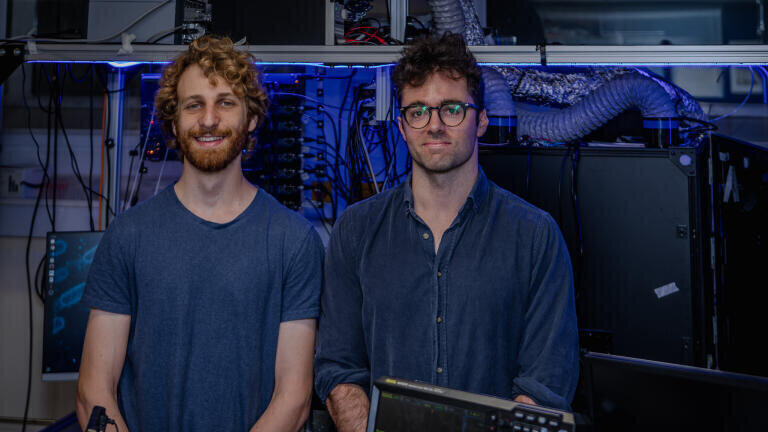
For the first time, researchers at the University of Oxford have engineered quantum effects inside proteins, opening the door to a new class of ‘quantum-enabled’ biological technologies.
The study [1], published in Nature, reports the creation of magneto-sensitive fluorescent proteins (MFPs) that respond to magnetic fields and radio waves when illuminated with the right light. While quantum processes have been observed in nature - for example, in birds’ magnetic navigation - this is the first time they have been deliberately designed and harnessed for practical applications.
Using directed evolution, the team introduced thousands of genetic variants and selected those with improved magnetic sensitivity over multiple rounds. This ambitious approach combined expertise in engineering biology, quantum science, and artificial intelligence, marking a first in exploiting all three disciplines in tandem to create a new technology.
The researchers have already demonstrated a prototype imaging system capable of locating these engineered proteins inside living organisms, similar to MRI but with molecular precision. Potential applications include tracking gene expression, monitoring tumour changes, and targeted drug delivery.
Gabriel Abrahams, first author and PhD student, said: “What amazes me is the power of evolution - by steering the process in bacteria, Nature helped us design a quantum sensor we couldn’t have built from scratch.”
Associate Professor Harrison Steel, senior author, added: “This project shows how fundamental science - from bird navigation to humble oat proteins - can lead to technological breakthroughs. It’s a reminder that the path from discovery to application is rarely straight, but always exciting.”
With ongoing work funded by the EPSRC and BBSRC, the Oxford team is now exploring the full potential of quantum biology, from medical imaging to biotechnological innovation, in collaboration with international partners.
More information online
ILM 51.6 Sept 2026


 Product directory


.jpg)
.jpg)












,-photo-Karin-Allander.jpg)

.jpg)