Research news
A team of researchers from the University of Oxford has uncovered a surprising twist in quantum timekeeping: the act of reading a quantum clock consumes far more energy than keeping it ticking. Published in Physical Review Letters, the study [1] challenges long-held assumptions about the thermodynamics of tiny, ultra-precise clocks and offers fresh insights for future quantum technologies.
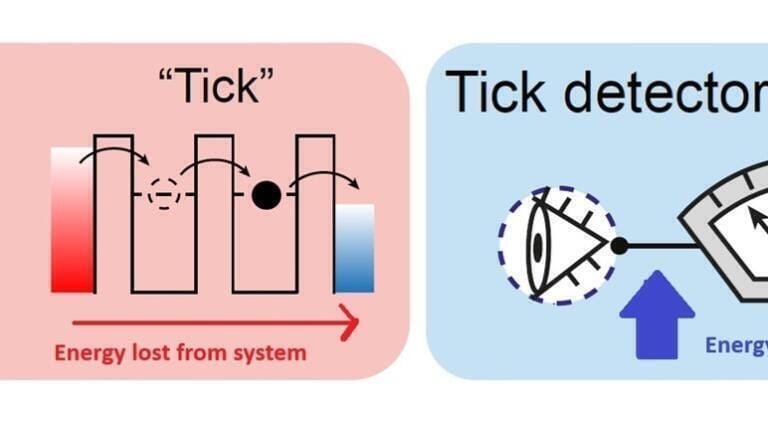
At the quantum scale, traditional timekeeping becomes tricky. While classical clocks rely on clearly irreversible processes to mark time, quantum systems operate in a nearly reversible realm, making energy-efficient timekeeping a challenge. To explore this, the researchers built a microscopic clock using single electrons hopping between two nanoscale regions. Each ‘jump’ acted as a tick, while measurement devices converted these quantum signals into classical data that could be recorded and analysed.
The findings were striking: converting the quantum ticks into readable information consumed up to a billion times more energy than the clock itself. In other words, observing the clock is far more costly than running it. This flips a common assumption that the focus should be on building better quantum clocks - researchers now suggest smarter, more efficient measurement strategies are key.
Lead author Professor Natalia Ares (Department of Engineering Science, University of Oxford) said: “Quantum clocks running at the smallest scales were expected to lower the energy cost of timekeeping, but our new experiment reveals a surprising twist. Instead, in quantum clocks the quantum ticks far exceed that of the clockwork itself.”
Beyond clocks, the work sheds light on fundamental physics. By showing that the act of measurement drives time’s forward direction, the study connects energy, information, and the flow of time in a profound way. Co-author Florian Meier said: “Beyond quantum clocks, this research touches on why time flows in one direction, showing that measurement - not just ticking - gives time its forward direction.”
The study also involved researchers from TU Wien and Trinity College Dublin, highlighting the collaborative nature of cutting-edge quantum research.
More information online
ILM 51.6 Sept 2026


 Product directory


.jpg)
.jpg)
















,-photo-Karin-Allander.jpg)




.jpg)